
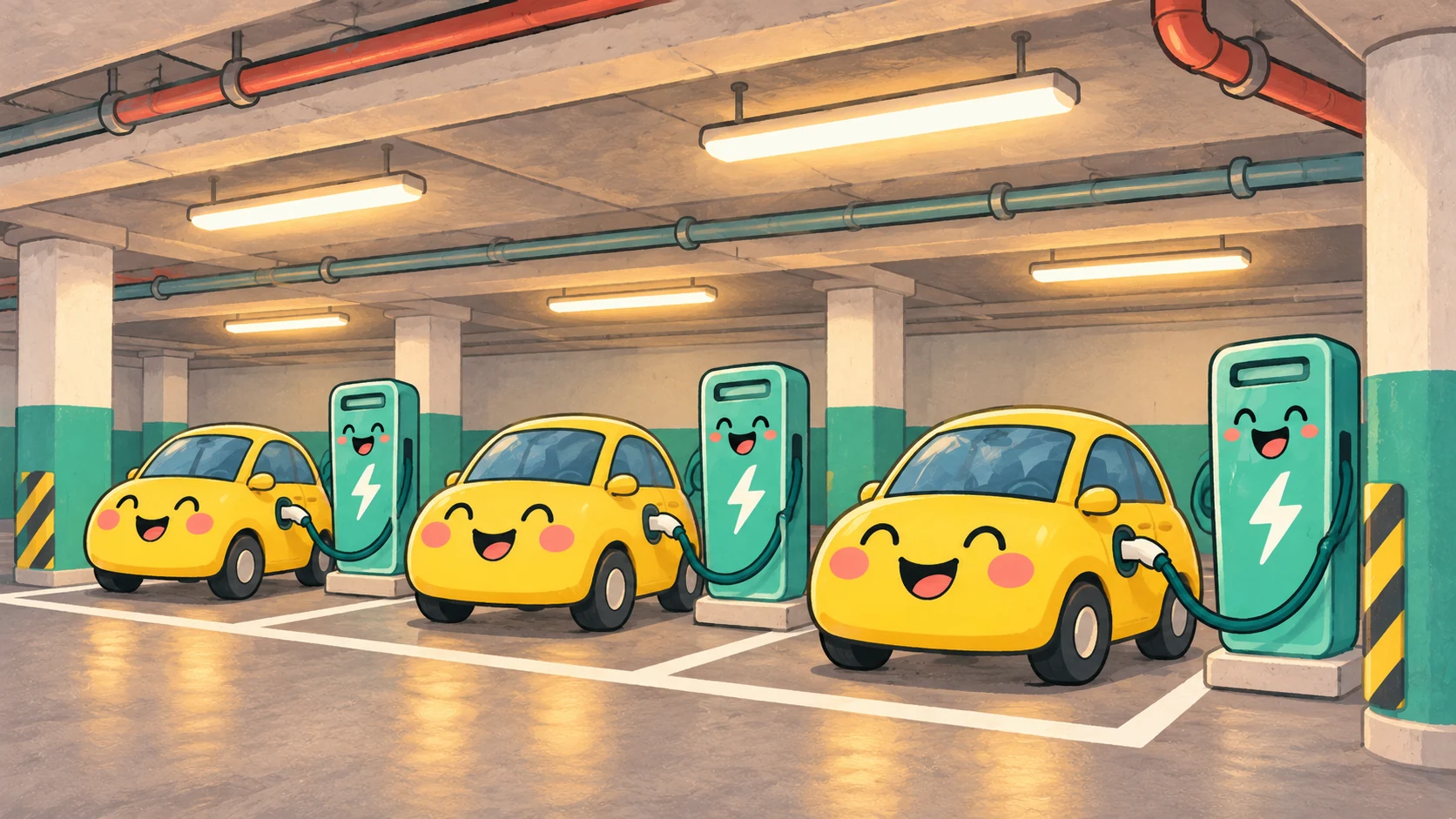
Several residents plug in their EVs after work. If the building’s charging system supports power sharing, it adjusts the power supplied to each car within a total limit. A charger marked 7 kW will not necessarily deliver that output whenever it is in use.
Do six 7 kW chargers need 42 kW?
They would need 42 kW to run at full output together. Now suppose only 21 kW is available for EV charging.
With an equal split between six cars, each would be allocated 3.5 kW. If only three cars remain charging, each could be allocated up to 7 kW, provided the cars and chargers support it.
These figures are a simplified example, not measurements from an actual building. The power delivered also depends on what each vehicle can accept, the wiring arrangement and the charger settings. Tesla’s power management guide describes sharing power between chargers while keeping their combined demand within a limit.
The charging limit can change with building demand
A charging installation may have a fixed power allowance. With suitable metering and controls, it can also adjust that allowance as the building’s electricity use changes.
When cooling or other building loads use more power, the system can reduce the amount allocated to EV charging. As building demand falls, more power can become available for the cars. This is called dynamic load management. Schneider Electric’s commissioning guide describes controlling charging according to the power available in a building in real time.
Not every installation supports this. Sharing power between chargers and responding to building demand are separate capabilities; whether they work together depends on the equipment and configuration.
Does every car get an equal share?
The calculation above assumes equal sharing. Actual allocation depends on the system’s operating rules. Systems that support priorities may distribute power differently, so counting the chargers alone will not tell you how quickly each car will charge.
This is relevant to shared residential parking beyond Korea. Singapore’s Land Transport Authority provides specific guidance on installing and operating chargers in condominiums and other private apartment buildings. LTA’s EV roadmap
To understand charging at your building, ask the property manager or charging operator: “What is the total charging power limit, and how is it shared when several cars plug in?” The answer will tell you more about everyday charging than the maximum rating on a single charger.

How GROO EV manages power across more chargers
GROO EV uses load balancing to adjust power across multiple chargers. By sharing power within a set overall limit, it supports operating more chargers on the available supply. The number of chargers a site can operate and the charging rate for each vehicle depend on the site’s electrical infrastructure and charging demand.
Explore charging operations software on the GROO EV page. For enquiries, use the “Chat with us” button at the bottom right.